
Game of Crowns 👑
Understanding Fillings, Crowns & Your Tooth Restoration Options
Sometimes a tooth starts with “just a small filling”… and years later ends up holding together by hope, coffee, and one remaining cusp 😅
One of the most common conversations we have at The Dental People is: “Can’t we just do a filling?”
And sometimes the answer is yes.
But sometimes a tooth has become too weakened, cracked, or structurally compromised to predictably survive with a filling alone — especially under daily chewing and biting forces.
Modern dentistry gives us several ways to restore damaged teeth, and the best option depends on:
how much tooth structure remains,
the location of the tooth,
bite forces,
cracks,
grinding habits,
aesthetics,
and long-term predictability.
At The Dental People, we only place composite (white) restorations — no silver/amalgam fillings are used in our practice. Let’s break down the most common restoration options 😊
What Is a Dental Restoration?
A dental restoration is anything used to repair or rebuild a damaged tooth.
Teeth may need restoration because of:
decay,
fractures,
cracks,
wear from grinding,
failed old fillings,
trauma,
or large cavities.
The goal is not only to “fill the hole,” but to restore:
strength,
function,
comfort,
and longevity.
Composite Fillings (“Tooth-Colour Fillings”)
Composite restorations are tooth-coloured fillings used to repair cavities, chips, or smaller defects. These are bonded directly to the tooth and are one of the most commonly performed dental procedures worldwide. At The Dental People, all direct fillings are composite restorations.
Best For:
Small to medium cavities
Front teeth
Cosmetic bonding
Minor fractures/chips
Conservative treatment
Pros:
✔ Tooth-coloured and aesthetic
✔ Minimally invasive
✔ Can often be completed in one visit
✔ Bonds directly to the tooth
✔ More conservative than crowns
Cons:
✖ Large fillings may weaken under heavy biting forces
✖ Can crack, wear, or de-bond over time
✖ Less predictable for severely broken-down teeth
✖ Large posterior fillings may fracture repeatedly
Longevity:
Typically 5–10 years depending on:
size,
oral hygiene,
bite forces,
grinding habits,
and diet.
Approximate Cost (South Africa):
Usually ± R900 – R2 000+ each, depending on the size and complexity.
When Is a Filling No Longer Enough?
This is where many patients become frustrated — especially if a tooth has already had:
multiple fillings,
repeated fractures,
large cracks,
or very little remaining tooth structure.
A filling works best when the tooth can still support itself.
However, once large portions of the tooth are missing, the remaining walls begin to flex under chewing pressure. Over time, this can lead to:
cracks,
fractured cusps,
sensitivity,
leaking restorations,
or even splitting of the tooth.
Sometimes replacing another large filling is possible temporarily — but it may not be the most predictable long-term solution.
When Is a Filling No Longer Enough?
This is where many patients become frustrated — especially if a tooth has already had:
multiple fillings,
repeated fractures,
large cracks,
or very little remaining tooth structure.
A filling works best when the tooth can still support itself.
However, once large portions of the tooth are missing, the remaining walls begin to flex under chewing pressure. Over time, this can lead to:
cracks,
fractured cusps,
sensitivity,
leaking restorations,
or even splitting of the tooth.
Sometimes replacing another large filling is possible temporarily — but it may not be the most predictable long-term solution.
Dental Crowns 👑
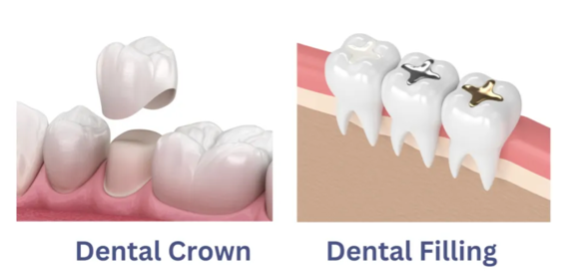
A crown is a custom-made “cap” that covers and protects a weakened tooth.
Crowns are commonly recommended when a tooth:
has extensive damage,
contains a very large filling,
is cracked,
is heavily worn,
or needs structural reinforcement.
Crowns are fabricated by a dental laboratory and designed specifically for your tooth.
Types of Crowns
There are several types of crowns available, including:
zirconia crowns
layered zirconia
porcelain-fused-to-metal (PFM)
full ceramic crowns
metal crowns
The best material depends on:
strength requirements
aesthetics
tooth position
bite forces
budget
At The Dental People, we discuss material options individually based on each case.
Why Are Crowns Stronger Than Fillings?
Unlike fillings, crowns surround and protect weakened cusps and tooth structure.
Think of it this way:
A filling repairs a damaged section of a tooth.
A crown reinforces and protects the entire tooth.
This becomes especially important in back teeth, where chewing forces are extremely high.
Best For:
Large cavities
Cracked teeth
Teeth with repeated filling failures
Severely worn teeth
Teeth requiring structural protection
Pros:
✔ Much stronger for heavily damaged teeth
✔ Protects weakened cusps
✔ Better long-term predictability in large defects
✔ Excellent aesthetics possible
✔ Helps reduce fracture risk
Cons:
✖ More expensive than fillings
✖ Requires laboratory fabrication
✖ More tooth preparation required
✖ Usually completed over multiple visits
Turnaround Time:
Usually 2–3 weeks depending on laboratory turnaround.
Longevity:
Crowns may last 10–20+ years with good oral hygiene and maintenance.
Approximate Cost (South Africa):
Usually ± R5 500 – R12 000+ depending on the material and laboratory used.
What About Inlays and Onlays?
Inlays and onlays are sometimes described as a “middle ground” between fillings and crowns.
They are laboratory-made restorations bonded onto the tooth and are designed to replace larger areas more predictably than direct fillings.
Inlays:
Fit within the cusps of the tooth.
Onlays:
Extend over one or more cusps to provide additional protection.
Best For:
Moderate to large defects
Teeth requiring cusp protection
Patients wanting conservative alternatives to full crowns
Pros:
✔ Stronger than large direct fillings
✔ More conservative than crowns
✔ Excellent fit and aesthetics
Cons:
✖ More expensive than fillings
✖ Requires laboratory work
✖ Multiple appointments needed
Turnaround Time:
Usually 1–3 weeks.
Longevity:
Often 10–15+ years with good maintenance.
Approximate Cost (South Africa):
Usually ± R4 000 – R10 000+ depending on material and complexity.
Why We Sometimes Recommend Crowns Instead of Fillings
Sometimes patients understandably prefer fillings because:
they are quicker
more affordable
less invasive
However, dentistry is not only about “what can be done today.” It is also about:
what will survive functionally
what protects the tooth long-term
what gives the most predictable outcome
There are situations where repeatedly replacing large fillings may eventually:
weaken the tooth further
increase fracture risk
lead to tooth loss
This does not mean every tooth automatically needs a crown. But it does mean that some teeth are simply under more stress than a filling can realistically tolerate long-term.
Final Thoughts
Every tooth is different.
Some teeth do beautifully with conservative composite restorations for many years. Others require additional reinforcement because too much structure has already been lost.
At The Dental People, our goal is always to:
preserve as much healthy tooth structure as possible,
discuss all realistic options openly,
and help patients make informed decisions based on function, longevity, aesthetics, and budget.
Sometimes a filling is enough 😊
And sometimes… it’s a Game of Crowns 👑
A Note on Front Teeth & Class IV Fillings
Front teeth are a little different from back teeth.
While they may not experience the same heavy chewing forces as molars, they are constantly exposed to:
biting forces,
shearing forces,
nail biting,
grinding,
accidental trauma,
and daily wear.
One of the most challenging restorations in dentistry is a Class IV composite restoration — a filling that replaces a fractured or missing corner/edge of a front tooth.
These often occur after:
trauma,
large old fillings,
decay,
edge fractures,
or wear.
Why Do Front Edge Fillings Sometimes Break?
A Class IV filling often has very little natural tooth support remaining.
Unlike smaller fillings that sit within the tooth, these restorations are frequently “hanging off” the edge of the tooth and relying heavily on bonding strength alone.
This means they may be more vulnerable to:
chipping,
debonding,
edge wear,
or repeated fracture.
Even beautifully placed composite restorations can fail over time if:
the bite is heavy,
there is grinding/clenching,
insufficient remaining enamel,
or the defect is very large.
Sometimes patients become frustrated when a front filling repeatedly chips — but the issue is often not the quality of the filling itself. The problem may be that there is simply not enough remaining tooth structure to support it predictably long-term.
Can Class IV Fillings Still Work Well?
Absolutely 😊
Composite bonding is an excellent and conservative treatment option for many front teeth, especially when:
enough healthy enamel remains,
bite forces are favourable,
and the defect is relatively small to moderate.
Modern composites can produce beautiful aesthetic results.
However, larger defects may sometimes require alternative or additional treatment options for better long-term stability.
Other reads:
If you'd like to understand the expected cost of dental treatment in Cape Town, consider reading our guide on How Much Does a Dentist Cost in Cape Town? (2026 Price Guide)
If you'd like to understand the details out teeth whitening service, consider reading it here: Quality Dental Services & Professional Teeth Whitening Cape Town
Book Your Appointment Today
Patients choose us for:
Convenient Milnerton location
Friendly and professional team
Comprehensive dental services
Transparent treatment recommendations
Positive patient reviews
We proudly serve patients throughout Cape Town and surrounding areas.
If you are searching for dental care in Cape Town, book an appointment with The Dental People today.
Our Milnerton practice welcomes both local residents and visitors seeking professional, reliable dental treatment.
Book Your Dental Appointment in Cape Town
Find us at
1 Loxton Road, Centre Point Shopping Centre, Milnerton, Cape Town
Working Hours
Monday - Friday: 8:30 AM - 16:30 PM
Saturday: 09:00 AM - 12:00 PM
Sundays & Public Holidays: Closed
Emergencies until 18:00 PM (Mon - Thu)
WhatsApp: 081 673 8958
Email: Info@TheDentalPeople.co.za