
Occlusal Splint vs Night Guard: What’s the Difference?
Jaw pain. Headaches. Clenching. Grinding. Clicking joints.
If you’ve been researching treatment options for TMJ/TMD symptoms, you’ve probably come across the terms occlusal splint and night guard.
Many patients assume these are the same thing — but they are actually quite different appliances with different purposes.
At The Dental People, we often see patients who have purchased over-the-counter guards or been given soft appliances elsewhere, only to find that their symptoms persist or sometimes even worsen.
Understanding the difference is important because the correct appliance depends entirely on the diagnosis.
What Is an Occlusal Splint?
An occlusal splint is a carefully designed dental appliance that is custom-made to influence how the teeth, muscles, and jaw joints function together.
These are typically fabricated using hard acrylic and are adjusted precisely by the dentist over multiple appointments.
Occlusal splints are commonly used in the management of:
TMJ/TMD disorders
Jaw joint pain
Muscle pain and fatigue
Clicking or locking joints
Severe clenching or bruxism
Bite instability
Certain headache patterns related to jaw tension
Unlike simple guards, occlusal splints are considered a therapeutic appliance rather than just a protective appliance.
Their goal is not only to protect the teeth, but also to:
reduce muscle hyperactivity
improve bite stability
redistribute forces
reduce strain on the TM joints
help relax the jaw musculature
There are different types of occlusal splints, including:
stabilization splints
Michigan splints
anterior bite planes
repositioning splints
The design depends on the patient’s symptoms and diagnosis.
What Is a Night Guard?
A night guard is primarily a protective appliance designed to shield the teeth from grinding and clenching damage during sleep.
Its main purpose is usually:• preventing tooth wear
reducing enamel fracture
protecting crowns, veneers, and fillings
minimising grinding damage
Night guards may be:
soft
dual laminate
hard acrylic
over-the-counter boil-and-bite
professionally fabricated custom appliances
A night guard does not necessarily treat TMJ dysfunction itself. For some patients, especially mild grinders without joint symptoms, a simple night guard may be sufficient. However, patients with:
joint pain
muscle pain
locking
headaches
bite changes
complex clenching patterns
often require a more carefully designed occlusal splint instead.
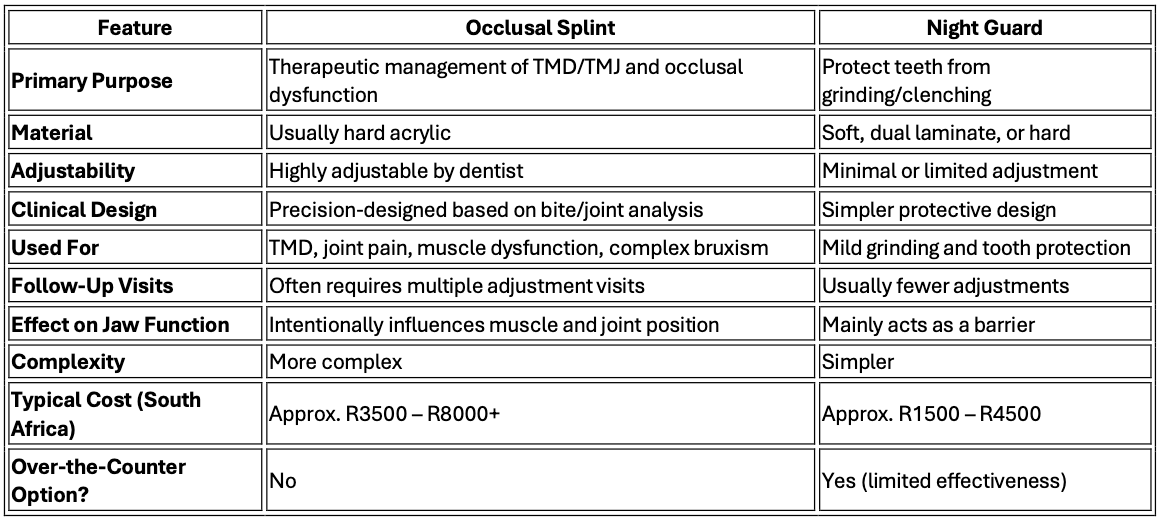
Occlusal Splint vs Night Guard: Key Differences
Indications and Uses of Each
Occlusal and Uses of Each:
TMJ pain
Facial muscle pain
Chronic jaw tension
Joint clicking or locking• Severe clenching
Bite instability
Morning headaches
Bruxism associated with muscle pain
Patients with worn dentition and collapse of vertical dimension.
Local anaesthetic.
Mild to moderate grinding
Protecting teeth from wear
Protecting crowns and veneers
Preventing fractures of restorations
Patients without significant TMJ symptoms
Mild clenching habits during sleep
Important Considerations
Not every patient with jaw pain needs an occlusal splint.
Similarly, not every grinder requires a complex TMJ appliance. The most important step is a proper examination and diagnosis.
This may include:
evaluating muscle tenderness
assessing jaw movement
examining tooth wear
checking joint sounds
identifying bite discrepancies
discussing stress and sleep habits
reviewing headaches and facial pain patterns
It’s also important to understand that splints are often part of treatment — not always the entire solution.
Other contributing factors may include:
stress and anxiety
posture
sleep quality
airway issues
missing teeth
unstable bites
orthodontic issues
lifestyle habits
In some cases, physiotherapy or specialist referral may also be appropriate.
Clinical Tips
1. Soft Appliances Are Not Always Better
Many patients assume softer means more comfortable — but soft appliances can sometimes encourage increased
clenching activity in certain patients.
2. Over-the-Counter Guards Have Limitations
Boil-and-bite guards may help temporarily, but they are rarely ideal long-term solutions for patients with significant TMD
symptoms.
3. Adjustment Matters
A well-made appliance still requires careful adjustment. Poorly adjusted appliances can worsen symptoms or alter the bite
over time.
4. Symptoms Can Mimic Other Conditions
Not all facial pain is TMJ-related. Tooth infections, sinus issues, nerve pain, headaches, and ear conditions can sometimes
present similarly.
5. Early Intervention Helps
Managing grinding and clenching early may help reduce long-term tooth wear, fractures, and joint strain.
Final Thoughts
The terms night guard and occlusal splint are often used interchangeably online, but clinically they can represent very different appliances.
The correct choice depends on:
your symptoms
your bite
muscle activity
joint health
the severity of grinding or clenching
At The Dental People in Cape Town, we take a conservative and individualised approach to jaw pain, grinding, and TMJ-
related concerns.
If you’re experiencing:
jaw pain
headaches
grinding
clenching
clicking joints
worn teeth
a proper assessment can help determine which appliance — if any — is most appropriate for you.
Written by Dr. Naidoo
BDS (Wits) | MBA (Wits) | MPH (UJ) | Over a decade of clinical experience, based in Cape Town
Published: 2026/05/28
Other reads:
If you'd like to understand the expected cost of dental treatment in Cape Town, consider reading our guide on How Much Does a Dentist Cost in Cape Town? (2025 Price Guide)
If you'd like to understand the details out teeth whitening service, consider reading it here: Quality Dental Services & Professional Teeth Whitening Cape Town
If you'd like comfort in understanding that dental treatment can be scary, read our latest article here
Book Your Appointment Today
Patients choose us for:
Convenient Milnerton location
Friendly and professional team
Comprehensive dental services
Transparent treatment recommendations
Positive patient reviews
We proudly serve patients throughout Cape Town and surrounding areas.
If you are searching for dental care in Cape Town, book an appointment with The Dental People today.
Our Milnerton practice welcomes both local residents and visitors seeking professional, reliable dental treatment.
Book Your Dental Appointment in Cape Town
Find us at
1 Loxton Road, Centre Point Shopping Centre, Milnerton, Cape Town
Working Hours
Monday - Friday: 8:30 AM - 16:30 PM
Saturday: 09:00 AM - 12:00 PM
Sundays & Public Holidays: Closed
Emergencies until 18:00 PM (Mon - Thu)
WhatsApp: 081 673 8958
Email: Info@TheDentalPeople.co.za