
To All The Teeth I’ve Lost Before - Understanding Your Tooth Replacement Options
ILosing a tooth can feel overwhelming — whether it’s one tooth, several teeth, or even a full arch. Some patients lose teeth due to decay, fractures, gum disease, failed root canals, trauma, or wisdom tooth complications. Others may have been missing teeth for years and are finally ready to restore their smile.
The good news?
Modern dentistry offers several ways to replace missing teeth — and there is no “one-size-fits-all” option. The best solution depends on your oral health, budget, long-term goals, and lifestyle.
At The Dental People, we help patients understand all available options so that treatment decisions feel informed, comfortable, and realistic.
Why Replacing Missing Teeth Matters
Missing teeth can affect more than just appearance. Over time, tooth loss may lead to:
Difficulty chewing
Shifting or drifting teeth
Bite changes
Jawbone shrinkage
Increased wear on remaining teeth
Speech difficulties
Lower confidence and self-esteem
Even replacing a single tooth can help preserve the balance and function of your mouth.
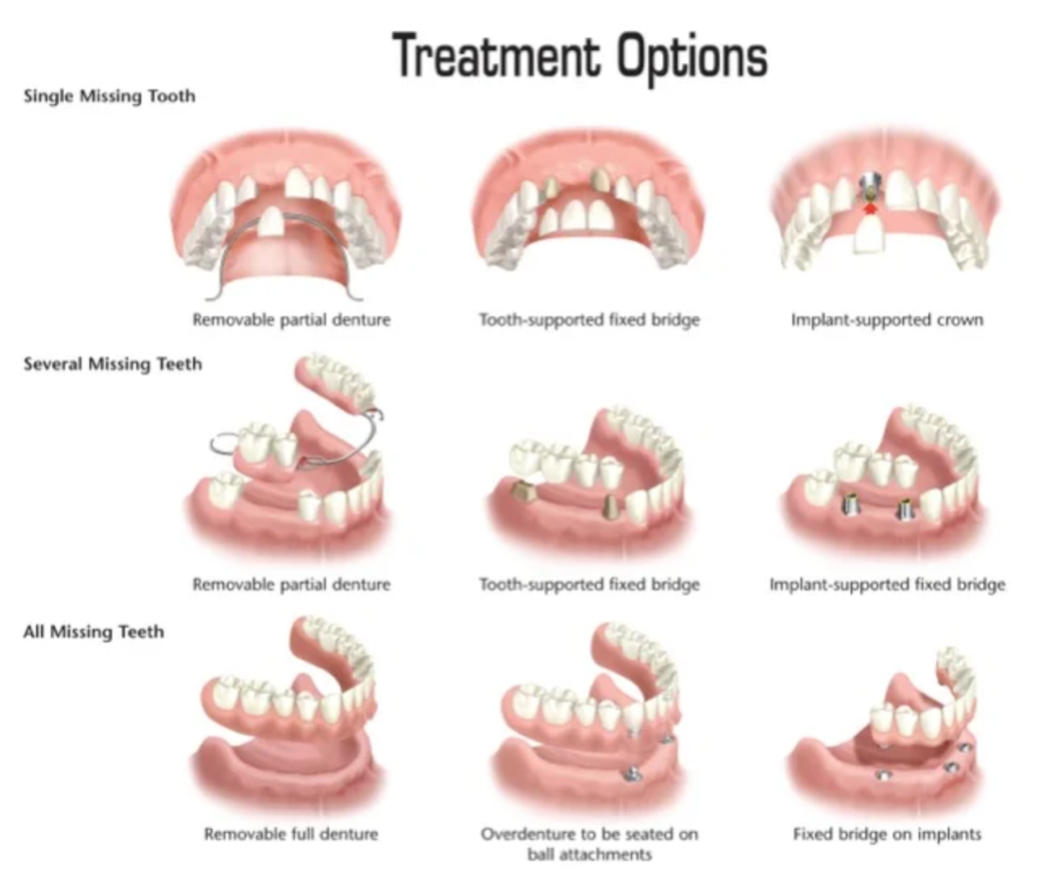
Tooth Replacement Options
1. Removable Partial Denture
A removable partial denture is a custom-made appliance that replaces one or multiple missing teeth. It clips or rests around your remaining natural teeth and can be removed for cleaning.
Best For:
Multiple missing teeth
Patients wanting a more affordable solution
Patients not suitable for implants or bridges
Pros:
✔ Most affordable option
✔ Non-surgical
✔ Can replace several teeth at once
✔ Relatively quick turnaround
✔ Easy to repair or modify if more teeth are lost later
Cons:
✖ Removable (not fixed permanently)
✖ May feel bulky initially
✖ Can move slightly during eating or speaking
✖ Clasps may sometimes be visible
✖ Requires daily removal and cleaning
Turnaround Time:
Usually 1–3 weeks depending on laboratory stages and adjustments.
Longevity:
Typically 5–10 years with proper care, although relines or adjustments may be needed over time.
Approximate Cost (South Africa):
Acrylic partial denture: ± R7 500 – R10 000
Chrome/cobalt partial denture: ± R10 000 – R17 000+
1.1. Flexible / “Flipper” Partial Denture
A flipper (sometimes called a flexi partial) is a lightweight removable appliance designed to replace one or a few missing teeth — often in a smaller segment of the mouth. These are commonly used as temporary aesthetic replacements, especially for front teeth.
Depending on the design and material used, they may be:
acrylic-based (“flippers”), or
flexible nylon-type partial dentures (“flexi dentures”).
They are popular because they are relatively affordable, minimally invasive, and can improve appearance quickly while patients consider more permanent options.
Best For:
Replacing one or a few missing teeth
Front tooth spaces
Temporary tooth replacement during healing
Patients wanting a quick cosmetic solution
Patients saving toward implants or bridges
Pros:
✔ More aesthetic than some traditional partial dentures
✔ Lightweight and comfortable
✔ Quick turnaround time
✔ Minimally invasive
✔ More affordable than fixed options
✔ Good temporary or transitional solution
Cons:
✖ Not as durable as bridges or implants
✖ Removable appliance
✖ Can stain or wear over time
✖ May loosen with long-term use
✖ Not ideal for heavy chewing forces
✖ Usually considered a temporary or medium-term option
Turnaround Time:
Usually 3–7 working days depending on laboratory turnaround.
Longevity:
Typically 1–5 years depending on the material, fit, and how often it is worn.
Approximate Cost (South Africa):
Usually ± R8 000 – R10 500 depending on:
the number of teeth replaced,
the material used,
and laboratory complexity.
1.2 A Note on Temporary Tooth Replacement
Many patients use a flipper or flexi partial as a “stepping stone” while planning for future treatment such as:
implants,
bridges,
or more definitive dentures.
This can be especially helpful after extractions, during implant healing periods, or while budgeting for long-term treatment.
2. Dental Bridges
A dental bridge replaces a missing tooth by using the neighbouring teeth for support. The replacement tooth (pontic) is “bridged” between adjacent teeth.
There are different types of bridges.
Traditional Bridge
A traditional bridge involves preparing (shaping) the teeth on either side of the missing tooth to support crowns.
Best For:
One or two missing teeth
Strong neighbouring teeth with existing fillings/crowns
Patients wanting a fixed (non-removable) option
Pros:
✔ Fixed in place
✔ Feels natural
✔ Good aesthetics
✔ Faster than implants
✔ No surgery required
Cons:
✖ Healthy neighbouring teeth may need drilling/preparation
✖ Harder to clean underneath
✖ If one supporting tooth fails, the bridge may fail too
✖ Does not prevent bone shrinkage beneath the missing tooth
Turnaround Time:
Usually 2–3 weeks depending on laboratory fabrication.
Longevity:
Approximately 8–15 years with good oral hygiene and regular dental care.
Approximate Cost (South Africa):
Usually ± R15 000 – R25 000+ depending on the number of units and materials used.
Maryland Bridge
A Maryland bridge uses “wings” bonded to the back surfaces of adjacent teeth instead of full crowns.
Best For:
Front teeth
Younger patients
Conservative/minimally invasive treatment
Pros:
✔ More conservative than traditional bridges
✔ Less drilling of healthy teeth
✔ Good temporary or medium-term solution
✔ More affordable than implants
Cons:
✖ Not ideal for heavy biting forces
✖ Can de-bond or loosen over time
✖ Less durable than traditional bridges or implants
Turnaround Time:
Usually 1–2 weeks.
Longevity:
Approximately 5–10 years depending on bite forces and maintenance.
Approximate Cost (South Africa):
Usually ± R8 000 – R15 000+.
3. Dental Implants
Dental implants are considered the closest replacement to a natural tooth. A titanium implant is placed into the jawbone, where it acts as an artificial tooth root. Once healed, a crown is attached.
Implants can replace:
One tooth
Multiple teeth
Full arches
Even support dentures
Best For:
Patients wanting a long-term fixed solution
Good bone support and oral health
Patients seeking the most natural feel and appearance
Pros:
✔ Closest option to a natural tooth
✔ Helps preserve jawbone
✔ Does not damage neighbouring teeth
✔ Excellent aesthetics and function
✔ Long lifespan
✔ Fixed and stable
Cons:
✖ Most expensive option
✖ Requires surgery
✖ Healing period required
✖ Not all patients are suitable candidates immediately
✖ Bone grafting may sometimes be needed
Turnaround Time:
Typically 3–6 months from implant placement to final crown, depending on healing and whether grafting is required.
Longevity:
Implants can last 15–25+ years with excellent oral hygiene and regular maintenance.
Approximate Cost (South Africa):
Single implant + crown: ± R20 000 – R35 000+
Implant-supported dentures/full arch cases: significantly more depending on complexity
4.Immediate Dentures — “Teeth on the Same Day”
For some patients, the thought of being without teeth — even temporarily — can feel extremely stressful emotionally, socially, or professionally.
An immediate denture is a denture that is made before the teeth are extracted and inserted immediately after the extractions are completed. This means the patient leaves with replacement teeth on the same day.
Immediate dentures can be made for:
full dentures,
partial dentures,
or selected segments depending on the case.
Best For:
Patients wanting an immediate cosmetic replacement
Front teeth extractions
Multiple extractions
Patients who do not want to appear “without teeth” during healing
Pros:
✔ Immediate aesthetic replacement
✔ Helps patients feel more comfortable socially
✔ Can assist with speech and confidence
✔ Acts like a protective “bandage” over extraction sites
✔ Allows transition into dentures more comfortably
Cons:
✖ Gums and bone shrink significantly during healing
✖ Multiple adjustments are usually required
✖ Relines may be necessary after healing
✖ Final fit immediately after extractions is less predictable
✖ Often considered a temporary or transitional prosthesis before a definitive denture
Important Healing Consideration
After extractions, the gums and underlying bone naturally change shape as healing occurs. Because of this, immediate dentures often become looser over the following weeks and months. An immediate denture is NOT a permanent denture. A permanent “final” denture is made 6-8 months after extractions are done, once healing has stabilised.
Patients should expect:
follow-up adjustment visits,
possible soft liners/rebases,
Turnaround Time:
Planning usually begins before the extraction appointment, with laboratory stages completed in advance.
Longevity:
Immediate dentures are often transitional appliances, although some patients may use them long-term with modifications and relines.
Approximate Cost (South Africa):
Costs vary depending on:
the number of teeth being replaced,
whether the denture is full or partial,
and laboratory complexity.
Approximate ranges:
Immediate partial denture: ± R6 500 – R9 000
Immediate full denture: ± R8 000 – R14 000+
A Note from The Dental People
Immediate dentures can be life-changing for patients who are anxious about appearance after extractions. However, it is important to understand that healing is a process — and adjustments are a normal part of treatment.
At The Dental People, we guide patients through each stage carefully so expectations remain realistic, comfortable, and well-supported 😊
Which Option is Best?
There is no universally “best” option — only the best option for you.
Some patients prioritise:
affordability,
speed,
longevity,
aesthetics,
comfort,
or avoiding surgery.
At your consultation, we assess:
your remaining teeth,
bone support,
bite,
gum health,
medical history,
and budget considerations.
We then discuss which options are realistic and appropriate for your specific case.
Can Missing Teeth Be Left Alone?
Sometimes patients adapt surprisingly well to missing teeth — especially if the space is not visible. However, over time, untreated gaps may contribute to:
drifting teeth,
gum problems,
bite collapse,
jaw strain,
and difficulty cleaning.
Early replacement is often simpler and more predictable than waiting years.
Final Thoughts
Tooth loss can feel emotional and frustrating — but modern dentistry gives us many ways to restore comfort, function, and confidence.
Whether you are looking for:
a simple removable option,
a fixed bridge,
or a long-term implant solution,
our goal at The Dental People is to help you understand your choices clearly and comfortably, without pressure.
Every smile is different — and every treatment plan should be too 😊
Thinking About Replacing Missing Teeth?
We recommend starting with a consultation so we can:
assess the missing area,
discuss your goals,
review costs and timelines,
and determine which option may work best for you.
Written by Dr. Naidoo
BDS (Wits) | MBA (Wits) | MPH (UJ) | Over a decade of clinical experience, based in Cape Town
Published: 2026/05/28
Other reads:
If you'd like to understand the expected cost of dental treatment in Cape Town, consider reading our guide on How Much Does a Dentist Cost in Cape Town? (2026 Price Guide)
If you'd like to understand the details out teeth whitening service, consider reading it here: Quality Dental Services & Professional Teeth Whitening Cape Town
Book Your Appointment Today
Patients choose us for:
Convenient Milnerton location
Friendly and professional team
Comprehensive dental services
Transparent treatment recommendations
Positive patient reviews
We proudly serve patients throughout Cape Town and surrounding areas.
If you are searching for dental care in Cape Town, book an appointment with The Dental People today.
Our Milnerton practice welcomes both local residents and visitors seeking professional, reliable dental treatment.
Book Your Dental Appointment in Cape Town
Find us at
1 Loxton Road, Centre Point Shopping Centre, Milnerton, Cape Town
Working Hours
Monday - Friday: 8:30 AM - 16:30 PM
Saturday: 09:00 AM - 12:00 PM
Sundays & Public Holidays: Closed
Emergencies until 18:00 PM (Mon - Thu)
WhatsApp: 081 673 8958
Email: Info@TheDentalPeople.co.za